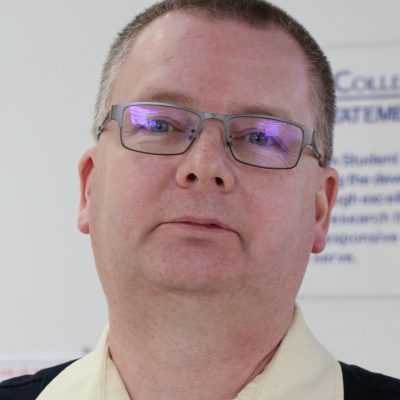
Fernando Galvez

Position
Facilitator, Research Development
Location
North Slave Research Centre
Phone
867-767-8212
Email
fgalvez@auroracollege.ca
ari_logo_circle_colour_2

Fernando Galvez has over 30 years of university research experience. He received his PhD from McMaster University with a focus on the effects of water chemistry on the bioavailability of metals in fish. He later completed postdoctoral fellowships at the University of Alberta, the University of Waterloo, and McMaster University. Before joining ARI, Fernando was a faculty member of the Department of Biological Sciences at Louisiana State University managing a research laboratory and studying the effects of environmental stressors on animal health. He procured over $3.1 million USD from diverse federal funding sources. He has used his research to inform federal policy, including testifying to a committee of the U.S. House of Representatives, the research on the environmental effects of the Deepwater Horizon oil spill in coastal Louisiana. Over the last decade, Dr Galvez has served on multiple grant review panels for federal programs supporting scientific research in Canada. He served as a member of the Natural Sciences and Engineering Research Council of Canada (NSERC)'s Discovery Grants Program. He has also reviewed grants for multiple Canadian and international research programs. In his previous role, Fernando chaired the Institutional Animal Care and Use Committee. He also was part of the leadership team on the Quality Enhancement Plan accreditation to the Southern Association of Colleges and Schools' Commission on Colleges.

Fern is originally from Kitchener, Ontario, and enjoys whitewater canoeing, hiking, tennis, and playing chess. Coming to the ARI from Baton Rouge in late October, 2024, he is joined by his wife MacKenzie and youngest son, Jonathan (his oldest son, Tomas, is studying at Brock University). 

As the Facilitator of Research Development for ARI, Fern is responsible for developing, supporting, facilitating, and expanding research activities across the institute.

Christopher Paci, PhD

Position
Vice President, Research
Location
Western Arctic Research Centre (Inuvik), North Slave Research Centre (Fort Smith), South Slave Research Centre (Yellowknife)
Phone
867-767-8210
Email
CPaci@auroracollege.ca
chris_paci_headshot_balanced

Chris Paci, PhD, brings a wealth of experience to his new role as Vice President Research at Aurora College’s research division, Aurora Research Institute (ARI). After several years in Ontario's college system, where he held roles including Dean, Associate Dean, and Chair, Chris is excited to lead research initiatives at the ARI.

Chris’s diverse background spans academia and management. He has taught and developed programs and courses at colleges and universities, managed initiatives at Indspire, the Metis Nation of Ontario, and managed the Lands and Environment program for the Dene Nation where he also advised the Arctic Athabaskan Council. Chris has served as Executive Assistant to the Chiefs of the Yellowknives Dene and he spent a year with the Government of the Northwest Territories before leaving the north to work in the south. His interdisciplinary doctorate is from the University of Manitoba, Natural Resources Institute, and he has experience as a consultant working for the Deh Cho Chiefs, West Point First Nation, and a range of other clients.

In addition to his academic and professional achievements, Chris has served on local, national and international boards, including the Folk on The Rocks, Friends of Gatineau Park, Sierra Club of Canada Foundation, and the Great Lakes Water Quality Board. Chris has family in Yellowknife and he is committed to sustainable development, continuous improvement, and empowerment (decolonization).

An avid cross-country skier, runner, cyclist, and home cook, Chris looks forward to spending time with his two eldest children and their families while advancing research excellence at Aurora College's campuses in Inuvik (Western Arctic Research Centre), Fort Smith (South Slave Research Centre), and Yellowknife (North Slave Research Centre).

Christina Martin

Position
Research Grants Coordinator
Location
Western Arctic Research Centre (Inuvik)
Phone
867-777-3298
Email
christina.martin@auroracollege.ca
ari_logo_circle_colour

Growing up on a farm in southern BC, I was influenced by my grandfather’s passion for northern Canada. I moved ‘north’ to Prince George and graduated with a BSc in Natural Resource Management from UNBC, then moved more properly North to Inuvik in 2004. I worked with the Inuvialuit-owned branch of Golder Associates for 8 years, conducting field work across the high Arctic and learning the importance of good proposal writing, effective project execution and appropriate reporting.

After a period away, I returned to Inuvik in 2021 and worked for the Gwich’in Tribal Council as their Research and Data Management Coordinator. This role amplified my interest in both research and data management, and inspired a transition to the ARI. As the Research Grants Coordinator, I manage research administration processes, and track the research projects and activities of Aurora College's broad research community. I compile research metrics, promote research funding opportunities, liaise with funders, and aim to support the college's researchers and diverse staff in effective and encouraging ways. It is a privilege to work with such talented and enthusiastic colleagues!

Dr. David Schwarz

Position
Manager, Applied Energy Research Programs
Location
Aurora Research Institute (Inuvik)
Phone
867-777-3298 ext. 252
Email
David.Schwarz@auroracollege.ca
david_schwarz_photo

Education

Ph.D. degree in Astronomy from the University of Cambridge

M.A.Sc. degree in Mechanical Engineering from the Institute for Integrated Energy Systems, University of Victoria

M.Sc. degree in Astronomy from the University of Toronto

B.Sc. degree in Physics from the University of Alberta


Research statement

I have more than 20 years experience leading applied energy research. I have developed and managed programs in industry for wind and solar preliminary assessment, monitoring and resource assessment engineering work, and tested and assessed emerging technologies and processes for use in operational implementations. I have planned, implemented and directed activities for multi-disciplinary research programs and consortia projects in fuel cells and hydrogen as a Research Officer at the National Research Council of Canada (NRC). My research work at the NRC focused on the development and application of computational fluid dynamics (CFD) modelling tools for polymer electrolyte membrane (PEM), direct methanol and solid oxide fuel cells in the development/validation of industrial-scale unit cell and stack designs for the penetration of target markets. I conducted research in multi-phase mass transfer models for gas diffusion layers and channels of fuel cells, enabling the development of sub-grid models for use in functioning stack models. I also developed CFD modelling tools for the analysis of hydrogen infrastructure and mass transfer in spacer filled membrane channels for separation processes. I have also managed research and development and new technology assessment and field testing programs and projects in the oil and gas industry.

I also have experience in operations, public strategy and policy development, and program and project performance management and evaluation: including as Senior Director of Science Policy, Operations and Evaluation in the Ministry of Economic Development, Trade and Tourism at the Government of Alberta. While at the Government of Alberta, I directed the development of the Climate Change Innovation and Technology Framework, which guided investments under Alberta’s Climate Leadership Plan in research, innovation and technology for climate change mitigation, and the associated performance management and evaluation plan (including the calculation of greenhouse gas emission reductions). I also directed work on the development of a provincial science policy and related action plan, including providing a grant to the Council of Canadian Academies to conduct an expert-based assessment on science policy for Alberta and publish a report “Science Policy: Considerations for Subnational Governments" for which I was a speaker in the panel session "Leveraging Federal Science: How Provinces Can Make a Difference in Strengthening Canadian Knowledge Production" at the 2017 Canadian Science Policy Conference in Ottawa.

My current research focuses on conducting wind and solar resource assessment monitoring campaigns in communities throughout the Northwest Territories. Wind resource assessment is the systematic collection of wind data at a potential site for the installation of wind turbines. Lidar has emerged as a powerful tool to remotely sense wind characteristics via measurement of the Doppler shift of light emitted by the lidar and scattered back from particles in the atmosphere such as dust, moisture and pollen. This ability to remotely measure wind characteristics allows lidars to be used where it is practically difficult or financially impractical to install metrological towers. Measurements of a variety of meteorological parameters are typically taken with lidars over the course of several years. The measurements can be used to estimate the future power output of a variety of wind turbines, design wind turbine layouts, and estimate a site’s potential annual energy production, which will help communities make vital decisions about future wind energy projects.

Contrary to a few short years ago, the routine collection of site-specific solar resource data has quickly become standard practice in the solar photovoltaic (PV) industry, just as it is in wind. Solar resource assessment refers to the analysis of a prospective solar energy production site with the end goal being an accurate estimate of that site’s potential annual energy production. Over a period of one to several years, solar sensors mounted on short masts are used to measure the solar resource. Data from a variety of other meteorological sensors are also collected to help characterize the resource, estimate PV panel efficiency and inform solar PV panel design decisions for the communities.


Significant contributions

Schwarz, D. H., Beale, S. B., 2009, Calculations of Transport Phenomena and Reaction Distribution in a Polymer Electrolyte Membrane Fuel Cell, International Journal of Heat and Mass Transfer, vol. 52, pp. 4074-4081.

Beale, S. B., Schwarz, D. H., Malin, M. R., Spalding, D. B., 2009, Two-Phase Flow and Mass Transfer within the Diffusion Layer of a Polymer Electrolyte Membrane Fuel Cell, Computational Thermal Sciences, vol.1, pp. 105-120.

Schwarz, D. H., Djilali, N., 2009, Three-Dimensional Modelling of Catalyst Layers in PEM Fuel Cells: Effects of Non-Uniform Catalyst Loading, International Journal of Energy Research, vol. 33, pp. 631-644.

Schwarz, D. H., Djilali, N., 2007, 3D Modeling of Catalyst Layers in PEM Fuel Cells: Effects of Transport Limitations, Journal of the Electrochemical Society, vol. 154, pp. B1167-B1178.

Schwarz, D. H., Pringle, J. E., 1996, A Self-Colliding Stellar Wind Model for SN1979C, Monthly Notices of the Royal Astronomical Society, vol. 282, pp. 1018-1026.

Martin, P. G., Schwarz, D. H., Mandy, M. E., 1996, Master Equation Studies of Collisional Excitation and Dissociation of H2 Molecules by H Atoms, Astrophysical Journal, vol. 461, pp. 265-281.


Jeff Sutton

Position
Information Technology Analyst
Location
Aurora Campus, Aurora College (Inuvik)
Phone
867-777-7818
Email
JSutton@auroracollege.nt.ca
ari_logo_circle_colour

Responsibilities

As the Information Technology Analyst at the Aurora Campus, Aurora College in Inuvik I am responsible for developing, implementing, and managing Information Technology (IT) and Telecommunications Systems. 

Malcolm Gorrill

Position
Finance Officer
Location
Aurora Campus, Aurora College (Inuvik)
Phone
867-777-7827
Email
MGorrill@auroracollege.ca
malcom_edited

Education

Bachelor of Arts (UPEI); Journalism Diploma (Holland College); Business Administration Diploma (Aurora College)

Responsibilities

Various accounts payable and accounts receivable duties, including taking payments, paying bills and generating invoices.